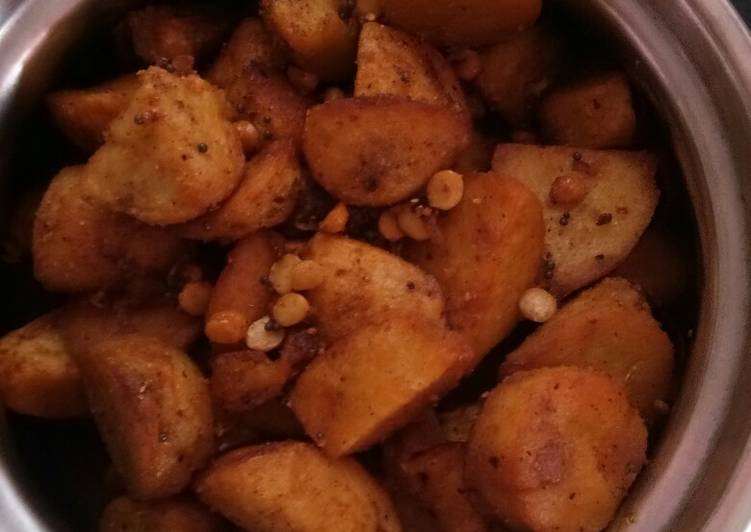
Hey everyone, I hope you are having an incredible day today. Today, I will show you a way to prepare a special dish, cheppankizhangu / arbi varuval / taro root. One of my favorites food recipes. This time, I’m gonna make it a little bit unique. This will be really delicious.
How to make taro root fry/arbi roast/cheppangkizhangu varuval - with Step by Step pictures. We prefer cheppankizhangu varuval without any tempering added to it. The heat and the slight stickiness from the taro root will help to coat the seasoning.
Cheppankizhangu / Arbi Varuval / Taro root is one of the most favored of current trending meals in the world. It is appreciated by millions daily. It’s easy, it’s fast, it tastes yummy. Cheppankizhangu / Arbi Varuval / Taro root is something which I have loved my entire life. They’re fine and they look wonderful.
To get started with this recipe, we must first prepare a few ingredients. You can have cheppankizhangu / arbi varuval / taro root using 9 ingredients and 6 steps. Here is how you can achieve it.
The ingredients needed to make Cheppankizhangu / Arbi Varuval / Taro root:
- Make ready 500 gms Cheppankizhangu / Arbi
- Prepare 1 tbsp Red chilli powder
- Prepare 1/2 tsp Turmeric powder
- Get 1 tbsp cornflour
- Get as per taste Salt
- Get as per need Oil
- Take as needed Curry leaves
- Prepare For seasoning
- Take a pinch each Mustard,chanadal,urad dal and hing (bengal gram,black gram,asafoetida)
However I prefer shallow frying in a Tawa. Indian Baked Taro Root fry (Arbi, Colocasia, Cheppankizhangu) Recipe. Broiling makes this one of the best Low calorie version of the real thing! Better than Oven roast, it helps to reduce not only fat but also retain its taste.
Instructions to make Cheppankizhangu / Arbi Varuval / Taro root:
- Soak the Cheppankizhangu /Arbi in water for 5 min and wash them to get rid of mud.
- Cut it into 2 or 3 pieces.Boil it in a pan just till it is half or little more cooked. If it is overcooked then it will become sticky.Peel the skin of Cheppankizhangu.You can see in the pic how it is non-sticky and separate.
- Now in a kadai pour oil and just fry cheppankizhangu.Not deep fry.Fry it till it turns little golden brown in colour.Even after frying all of it you can check the oil in the kadai.I mean to say more oil is not required for frying.
- Remove fried kizhangu in a stainer.Now add salt,turmeric powder,red chilli powder and little cornflour flour.You can also sprinkle little rice flour.
- Now in the same kadai remove excess oil.In 2 tbsp oil add mustard seeds,chanadal,urad dal,hing and curry leaves..After it splutters add the kizhangu and fry it on low flame for 3 to 4 mintues.
- The kizhangu / Arbi is completely roasted and ready to eat.
Taro root / Colocasia is known as Chama Dumpa in Telugu, Arbi in Hindi, Seppankizhangu or Cheppankizhangu in Tamil and Chembu in Malayalam. In Indian, taro root is a common vegetable served in many ways, such as deep fried in oil, or cooked in a tamarind gravy with lots of Indian spices. Taro root fry, colocasia fry, taro root varucal, crispy arbi fry, seppankizhangu varuval, vegetarian sides, varuval recipes, deep fried foods, fries Do not add any water to this, final product will end up like a gooey mass. Add the taro root pieces to the dry masala powder and toss for a couple of times. The yummy taro root(Seppenkizhangu) roast is ready to serve with sambar or kuzhambu varieties.
So that’s going to wrap this up with this exceptional food cheppankizhangu / arbi varuval / taro root recipe. Thanks so much for your time. I am confident that you can make this at home. There’s gonna be more interesting food in home recipes coming up. Remember to bookmark this page in your browser, and share it to your family, friends and colleague. Thanks again for reading. Go on get cooking!